Master, house & chargeable weight — how consolidation math works
The freight concepts behind consolidation — master vs house shipments, and how Linbis computes the weight you actually charge.
Two ideas power most freight-forwarding operations: the master/house split that makes consolidation possible, and chargeable weight, the number you actually rate and invoice. Here is how both work — and how Linbis computes them.
Master and house shipments
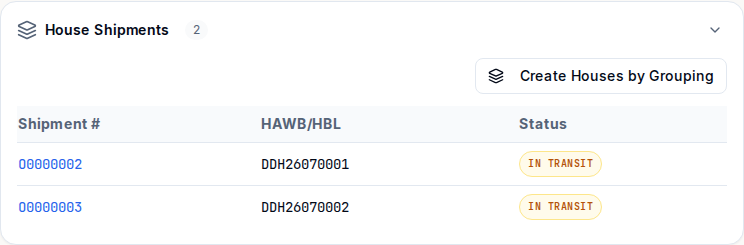
A master shipment is your contract with the carrier: one MAWB (Master Air Waybill) for air, one MBL (Master Bill of Lading) for ocean. A house shipment is your contract with each customer inside that move: its HAWB or HBL. Consolidation means several houses — several customers' cargo — travel under one master, sharing the carrier cost.
Rules worth knowing:
- A master requires its MAWB/MBL; a house requires its HAWB/HBL.
- A house does not need a master at creation. Standalone houses are valid; the master is assigned later during consolidation (see Consolidate house shipments under a master).
- In the shipments list, the Type column shows the class (Master/House) and whether the shipment is a Consol or Direct.
Chargeable weight
Carriers charge for whichever is greater: what the cargo weighs (gross weight) or the space it occupies (dimensional weight, computed from volume). That maximum is the chargeable weight:
chargeable weight = MAX(gross weight, dimensional weight), rounded upThe two transport modes measure "space" differently — and the numbers matter: air chargeable weight divides volume by the 1:6000 volumetric divisor (cm³ ÷ 6000 = volumetric kg, which is the same as 167 kg per CBM), while ocean uses the W/M convention (weight or measure — the revenue ton: 1,000 kg vs 1 CBM, whichever is greater).
Worked example — a pallet of 120 × 100 × 100 cm weighing 150 kg:
- Volume: 1.2 CBM (cubic meters).
- Air: 1,200,000 cm³ ÷ 6000 = 200 kg volumetric → chargeable weight 200 kg (the dimensional weight wins over the 150 kg on the scale).
- Ocean: 1.2 CBM vs 0.15 metric tons → rated on 1.2 revenue tons (measure wins).
Linbis applies this automatically: every cargo line carries its dims and volume, the shipment's Chargeable Weight appears alongside gross weight in quotes and shipments, and the value flows into the charges grid for rating. Defaults per mode are air 6000, ocean 1 CBM = 1,000 kg, ground 3000; where a different divisor applies you can pick it (International 6000, Domestic 7000, Courier 5000, Ground 3000), or a carrier-specific factor.
The shipment status flow
Consolidated or not, every shipment moves through the same canonical pipeline: Draft → Booked → Picked Up → At Origin → In Transit → At Destination → Out for Delivery → Delivered → Completed. Customs Hold is a branch on the way to destination, and Cancelled is reachable from any state. Your company can rename these stages per mode in Settings → Status Flow; underneath, the canonical statuses keep reporting consistent.